

















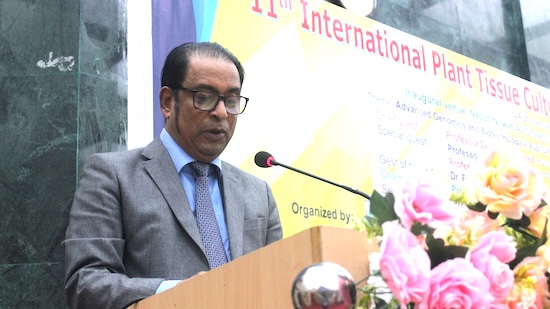
Special Correspondent: Highlighting the decisive role of modern science in addressing future agricultural challenges, Dr. F. H. Ansery, Group Advisor of ACI PLC and President of ACI Agribusinesses, said that advanced genomics, plant tissue culture and biotechnology have become indispensable for ensuring food security and environmental sustainability in Bangladesh.
Dr. Ansery made the remarks while speaking as Guest of Honour at the inaugural session of the 11th International Plant Tissue Culture & Biotechnology Conference, held at the Nabab Nawab Ali Chowdhury Senate Bhaban, University of Dhaka, on 24 January 2026, Saturday.
Addressing a gathering of eminent scientists, academicians, researchers and young scholars from home and abroad, he noted that global agriculture is facing unprecedented pressure from climate change, shrinking natural resources and the rising demand for food and nutrition. In this context, he emphasised that modern agriculture increasingly relies on genomics-driven breeding, genome editing and advanced biotechnological applications.
Referring to global advances, Dr. Ansery said technologies such as genome sequencing, genomic selection, doubled haploids and genome editing are enabling breeders to develop crop varieties that produce more with fewer inputs, tolerate heat, drought, pests and diseases, and significantly reduce environmental footprints.
He described plant tissue culture as a cornerstone of modern agriculture, noting that it supports national seed systems by producing clean, virus-free and uniform planting materials and allows for rapid multiplication of improved varieties. As a result, the global plant tissue culture sector is expanding rapidly and becoming an integral component of sustainable agricultural development.
Turning to Bangladesh, Dr. Ansery said the country has made notable progress in applied biotechnology, with tissue culture now firmly established in potato, banana, sugarcane, vegetables and ornamental crops, contributing to improved planting material quality and reduced disease incidence. He also welcomed the introduction of science-based regulatory frameworks for genome-edited plants, describing it as a forward-looking step toward innovation.
Sharing industry experience, he said ACI Agribusinesses currently produces more than half a million virus-free potato plantlets annually, directly improving seed health, yield stability and farmer confidence. He added that genomics-based hybridity testing is being used in rice and vegetable seeds to ensure genetic purity, while biotechnology-assisted selection is strengthening crop performance under changing climatic conditions.
Comparing Bangladesh with global leaders, Dr. Ansery observed that the country’s main challenge is not a lack of talent or expertise, but limitations in scale, automation and integrated collaboration. He stressed the need to develop a unified biotechnology platform that seamlessly integrates genomics, tissue culture and phenotyping.
“Advanced biotechnology can secure our food supply, reduce dependence on chemicals, protect soil, water and biodiversity, and build resilience against climate shocks. For a climate-vulnerable country like Bangladesh, this is not an option – it is a necessity,” he said.
Calling upon young scientists, Dr. Ansery urged them to translate research into real-world impact by taking biotechnology from the laboratory to farmers’ fields. He also appealed to international partners to strengthen collaboration in capacity building, technology transfer and farmer-oriented solutions.
The three-day conference was inaugurated by Professor Dr. Mamun Ahmed, Pro-Vice Chancellor (Academic) of the University of Dhaka, as Chief Guest, with participation from leading national and international experts in plant biotechnology.