














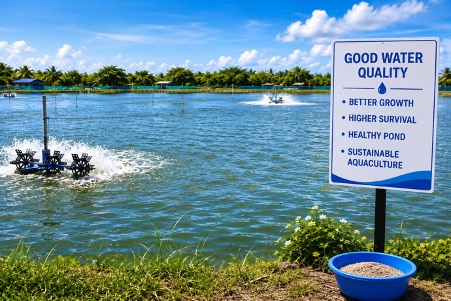
Aquaculture productivity largely depends on maintaining a stable and healthy aquatic environment. Poor water quality, excessive organic waste accumulation, ammonia toxicity, and harmful microbial proliferation are among the major challenges faced in intensive fish and shrimp farming systems. Modern aquaculture therefore increasingly relies on environmentally friendly biological solutions that improve pond ecology while supporting fish and shrimp health and their growth performance.
One of the most effective approaches is the use of multi-strain probiotic and mineral-based pond conditioning products. These formulations generally contain beneficial bacteria, nitrifying microorganisms, denitrifying agents, organic matter degraders, and essential minerals that work together to improve pond water quality and sediment conditions.
Beneficial bacterial strains such as Bacillus subtilis and Bacillus licheniformis play an important role in decomposing organic sludge, uneaten feed, and waste materials accumulated at the pond bottom. By accelerating organic matter degradation, these microbes reduce the formation of toxic gases such as ammonia, hydrogen sulfide, and methane, thereby creating a healthier culture environment.
Nitrifying bacteria including Nitrosomonas and Nitrobacter species contribute significantly to the nitrogen cycle in aquaculture ponds. Nitrosomonas converts toxic ammonia into nitrite, while Nitrobacter further converts nitrite into relatively less harmful nitrate. This biological nitrification process helps maintain safe water quality parameters, particularly in high-density culture systems where ammonia accumulation can rapidly affect fish and shrimp survival.
Denitrifying bacterial strains such as Pseudomonas denitrificans and Alcaligenes denitrificans assist in reducing excessive nitrate concentration by converting nitrate into nitrogen gas. This process supports ecological balance and prevents deterioration of pond water quality during long culture periods.
Lactic acid bacteria such as Lactobacillus helveticus and Lactobacillus lactis may help suppress opportunistic pathogenic microorganisms by competitive exclusion and production of beneficial metabolites. These bacteria also contribute to improved microbial balance in pond ecosystems.
Mineral components included in such formulations are equally important for maintaining water chemistry and biological activity. Calcium-rich marine minerals help stabilize pH and alkalinity, which are critical for microbial efficiency and fish//shrimp health. Trace minerals including magnesium, iron, manganese, copper, cobalt, silica, and phosphorus support microbial metabolism, enzymatic reactions, and overall pond productivity.
The application of probiotic-mineral pond conditioners can provide several advantages in aquaculture systems:
- Reduction of ammonia and nitrite toxicity
- Faster decomposition of organic sludge
- Improvement of dissolved oxygen dynamics
- Reduction of foul odor and harmful gas formation
- Enhancement of pond bottom condition
- Improvement of survival and growth performance
- Support for sustainable and eco-friendly farming practices
In modern sustainable aquaculture, biological pond management has become an essential alternative to excessive chemical usage. The integration of beneficial microbial consortia with mineral supplements offers an environmentally responsible solution for maintaining pond ecosystem stability, improving production efficiency, and reducing disease risks in both fish and shrimp culture systems.
Author : Pijush Sarkar Tulan
Country Manager (Bangladesh)
Biostadt India Limited.
M: +8801717979802
E: pijush.sarkar@biostadt.com
W: www.biostadt.com